Posts

Showing posts with the label Higher Education

How To Respond to Reviewers Comments (repost)

I am really excited in sharing with you this Webinar by Elsevier Publishing Campus  on how a researcher should deal with the reviewer's comments . I really encourage young researchers to sign up  to Elsevier Publishing Campus for free lectures and very interactive training. Whether it be your interested in writing a journal article, wondering how the peer review process is conducted or even understanding publishing ethics, whatever it may be, EPC has many resources to help researchers achieve some of their goals.  Often enough, authors are asked to revise their paper with minor or major revisions and in many other likely cases the paper is rejected. Regardless of the type of response, the authors receive a series of comments that have been forwarded from the reviewers to the editor .

How to Solve the World's Biggest Problems (repost)

Image
''  Interdisciplinarity has become all the rage as scientists tackle climate change and other intractable issue. But there is still strong resistance to crossing borders ... We have to bring people with different kinds of skills and expertise together. No one has everything that's needed. '' This is a repost of Heidi Ledford article in the Nature News  posted in September 2015. You can read the pdf or the html version.

10 of the most read stories from Authors Update in 2015 (repost)

Check out the most popular stories that have been read in the last 12 months in Elsevier. Click Here to read full article. 1) 3 top tips for responding to reviewer comments on your manuscript 2) Learn all you need to know about the publishing process with our free downloadable guides 3) Free access to journals for unemployed postdocs

New Editorial System EVISE

If your a researcher submitting your paper to a journal published through Elsevier, your familiar with their current submission system called EES (Elsevier Editorial System). The interface is very basic for an author point of view, but it is even more rigorous for the editors to work with. It is obvious it requires an updated version, particularly since competing journals have been using for years a more advanced editorial system. I'd like to share with you a detailed article about the new editorial system called EVISE, that is expected to be used by all Elsevier journals by October 2016.  Click here to read the full article. Please read, discuss and share ! 

How do Editors Look at Your Paper (repost)

'' When you are doing research you are primarily focused on your hypothesis, methods, test results and research outcome. You are an expert in your research field and are very aware of what others are researching and publishing too. But the actual art of gettign your own paper ready for publication requires quite some expertise and a great deal of serious attention and preparation.'' ( Source ) I really recommend you watch this online lecture that includes  valuable points that should be taken when you choose a journal for submission.  Q & A session: with Elsevier's Executive Publisher Jaap van Harten Moderator: Gwendolyn Holstege , Researcher Relation Manager at Elsevier  Click here to view the video. 

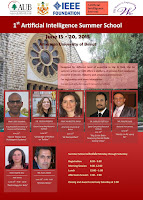
1st Artificial Intelligence Summer School at AUB

Image
An exciting event will be held this month at the American University in Beirut: 1 st Artificial Intelligence (AI) Summer School Over the course of six days, from June 15 th until June 20 th 2015 , the participants will be introduced to the fundamentals of AI as well as advanced concepts during seminars and workshops.  For more information and registration, click here and visit the Facebook page . 

Time for Academic Writing to Evolve

Here is a very nice article I stumbled while surfing the web. Time for academic writing to evolve, a leap from dull and boring writing towards a more modern and attractive style.  Please read, discuss and share....  Here is a small sample of the article, click here for full article [Source  Elsevier ].  " C ommunication is a vital part of the academic process: sharing results with your peers means your research builds the knowledge base, adding to our understanding of the universe and everything that goes on inside it. So why does the writing have to be so dull?

Webinar Writing Quality Technical Papers March 2015

Image
I will be attending this webinar on how to write a quality technical paper and where to publish it in IEEE given by Professor Saifur Rahman. Click here to visit his homepage, you can also view his Google Scholar profile here . Date and Time: March 3, 2015, 2:00 pm (-5 GMT) REGISTER HERE

Tips For Writing a Review Paper

Image
When my director proposed that I should begin writing a review article few month into my PhD program, reflecting on that moment now I would have hoped to cross a prep-article with some insights and tips on how to write a scientific review article. Unfortunately I did not, and now that I have finally submitted my second revision (fingers crossed that it will be finally approved for publication), I've noted for a while on my To-Do list the writing of this post. I will try to be as clear and honest as possible highlighting some tips to complete the task of writing a scientific review paper.    Yes it is unusual that a first year PhD student writes a literature review even before beginning his research. Most PhD candidates if not all must go threw the phase of a bibliographic study, reading hundreds of research papers, dissertations and reports to familiarize themselves with their thesis. Into their second year they've published one or two conference papers and writing a rev...

Conference CITEF 2014 - Lebanese University, Lebanon

Image
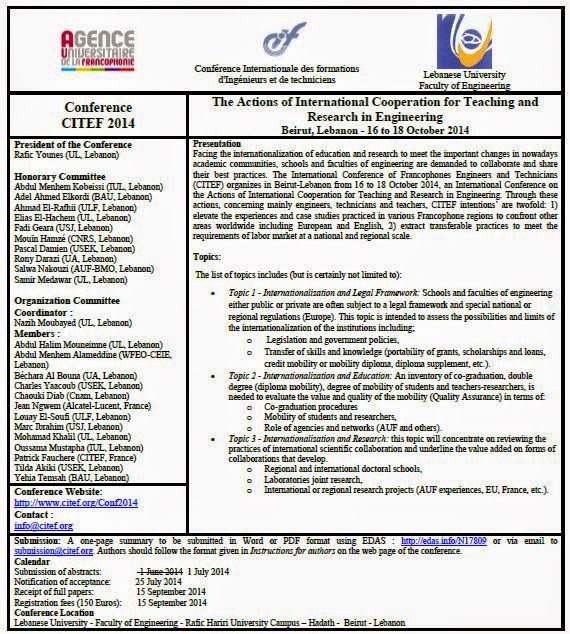
As a PhD student I try my best to surround myself with other researchers, experts and pioneers and when I am notified of a conference nearby, I try my best to find space in my calendar to attend. Now some might debate that the content of some lectures are outside their expertise and so their presence is of no use, but one cannot deny that science is converging towards multi-disciplinary at a high speed and in a direct or indirect way, your research will reach and become tangent with other fields we might today believe are distant but the future will most likely proof otherwise. Held at the Faculty of Engineering at the Lebanese University in Hadat, Beirut from the 16 till the 18 of October 2014 , CITEF 2014 (Conference International des Formations d'Ingenieurs et de Techniciens) examined the subject of international cooperation for teaching and engineering research. One can only congratulate and appreciate the work of Dean Rafic Younes (Lebanese University, Lebanon) for ma...

The Impact of Lebanon's Political Crisis on Academic Publication and Higher Education

Image
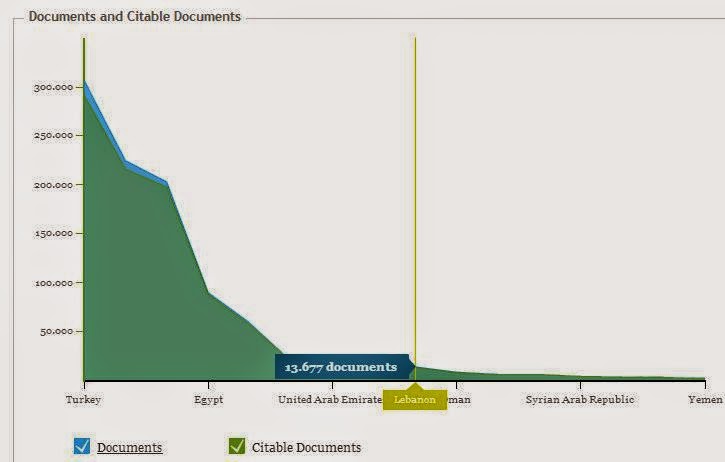
It doesn't take a genius to tell you that violence and triggered wars are occurring in the Middle East. As much of a pain it is to witness such violence and hate, there should be no place for pessimism. Therefore, this post is not aimed at discussing the reasons, but rather the impact of the political conflicts of the last decade on research publication in Lebanon, a small study that I hope will touch others, whom share the same responsibilities.  At first, if you are not familiar with  SCImago Journal & Country Rank , I suggest you get to know the SJR metric. It basis it algorithm on the information contained in the  Scopus  database (Elsevier) since 1996. It allows you to visualize, compare, and analyze the ranks of journals, countries and even regions. I based my analysis and study on the results generated by  SCImago   on the region of the Middle East; particularly on Lebanon.   Lebanon ranks 9th in the Middle East in ...

Tips for Publishing in Scientific Journals

Image
You have just finished writing your research paper and your advisor requested that you should start checking for possible journals to submit your paper... This is a common event to every PhD students, and in particular it is a new experience to first year PhD students. So here are few tips you should consider while publishing in a scientific journal based on my personal journey so far.  1. Evaluate Your Work... Please be Realistic !! Often students aim to publish their work in high-ranking journal. I will talk about journal rankings later, but do not exaggerate too much when evaluating the impact of your research if you are a first year PhD student and this is your first publication. Be realistic, and if you need advise, find a referee, a third person if you want, and based on his feedback, you will decide to either submit your work as a conference paper or to a scientific journal. You do not want to get yourself i...